
A familiar dead end
Amit spent six months in the ritual every aspirant knows: evening study blocks, a weekend mock, and a growth chart of scores that refused to become a trend. He could recount the last ten mocks in detail—percentiles, section ranks, a handful of ‘‘silly mistakes’’—but he couldn’t explain why the same DI sets kept consuming him for twenty minutes, or why short RCs repeatedly yielded wrong inferences. The problem wasn’t effort; it was that effort was arranged to produce data, not repair.
This scene repeats in coaching centers and forums. Full tests give the intoxicating appearance of progress—a single, easy metric to chase. That metric hides the mechanisms that tests reward under pressure: rapid pattern recognition, robust setup routines, and inference habits that transfer across formats. Volume without focused correction tends to preserve failure modes because mocks supply delayed, global feedback rather than the immediate, operation‑level feedback that drives learning.

The mock‑first orthodoxy and its hidden assumptions
Mocks are seductive for good reasons. They simulate timing, force endurance, and deliver a score that abstracts countless micro‑decisions. The standard advice—more tests, more hours—rests on two assumptions: exposure grows competence, and aggregate score is a sufficient proxy for ability. Both are partially true and often misleading. Exposure helps, but only when it is coupled with feedback that isolates the cognitive operation you want to change. And a composite score conflates distinct problems: conceptual gaps, setup inefficiency, calculation slowness, and strategic inconsistency.
Learning scientists have emphasised this distinction. Work on deliberate practice (Ericsson et al., 1993) argues that improvement requires targeted, iterative practice on specific component skills with informative feedback; transfer literature (Barnett & Ceci, 2002) warns that practicing in one context doesn’t guarantee the skill will emerge in another unless practice explicitly addresses variability and retrieval cues. In short: quantity without diagnostic feedback tends to produce brittle competence.

Why sheer volume stalls improvement
Three learning dynamics explain why students plateau when mocks dominate the schedule.
First, measurement without diagnosis. A mock tells you which questions were missed but rarely pinpoints the underlying operation that failed—was the error conceptual (misunderstanding principles), procedural (slow setup), or strategic (wrong approach under pressure)? Treating the score as the signal to chase obscures the signal’s components.
Second, practice without transfer. Repetitive full tests may build familiarity with surface features, but they don’t systematically strengthen atomic skills—translation of word problems into equations, rapid estimation, or mapping argument structure in dense prose. These components need varied, concentrated exposure so they can be retrieved reliably during a timed test.
Third, cognitive dilution. Time spent running full tests is time not spent deconstructing mistakes and rehearsing corrective routines. When remediation is shallow—glancing through solutions or ‘‘noting careless errors’’—the same mistakes reappear because the learner never addressed the proximate cause.
These are not claims of certainty but patterns consistent with research on feedback specificity and transfer: specific, immediate corrective feedback tends to accelerate learning more than broad, delayed performance feedback.
A skills‑first mental model for exam‑grade routines
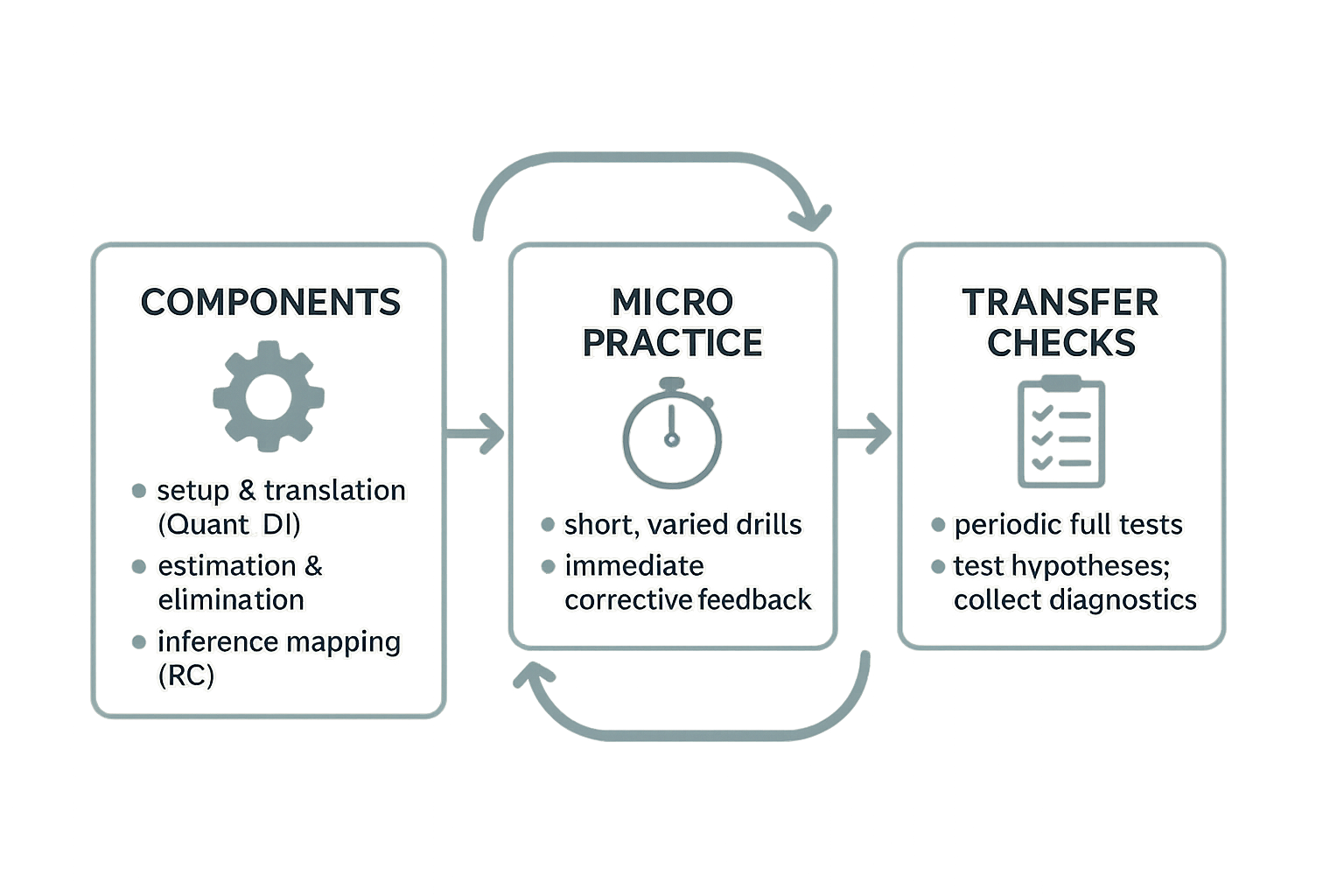
A more productive mental model rearranges priorities: identify the atomic skills the exam rewards; design brief, variable practice that isolates those skills; use full tests as transfer checks. Think in three linked levels:
-
Components. Disaggregate the exam into cognitive operations: setup and translation for quant/DI, estimation and elimination heuristics, inference and purpose mapping for RCs, and spotting structural traps in logical reasoning.
-
Micro practice. Use short, focused sessions that present varied instances of the same cognitive move and provide immediate corrective feedback. The aim is to make the operation automatic across surface differences.
-
Transfer checks. Periodic full tests verify whether components recombine under realistic time and stress. If a practiced micro‑skill fails in a mock, the mock becomes the diagnostic starting point for the next corrective cycle—not the primary mode of practice.
This approach follows the logic of deliberate practice: small units of performance, feedback closely tied to the intended operation, and repetition until fluency. It also addresses transfer by varying practice contexts so retrieval cues approximate test conditions.
How to repurpose mocks and measure change
Treat a mock as a controlled experiment rather than the training session itself. That shifts the question from "How did I score?" to "What hypothesis did this test confirm or falsify?" Before a mock, decide the operational hypothesis you will test (for example: ‘‘Does committing to a two‑pass RC strategy reduce time on short passages without increasing errors?’’). During the mock, constrain behaviour to test that hypothesis—apply the chosen approach consistently. After the mock, conduct a focused review: for each mistake, record the cognitive operation that failed and assign a short remediation.
Define simple, measurable signals of real learning. Useful indicators include a falling frequency of the same conceptual mistake across sessions, narrower variance in time per question for comparable items, a shift from concept errors to occasional slips, and the ability to execute a practiced micro‑skill during a timed mock without external prompts. Track repeat errors as a rate—for example, identical‑concept mistakes per 100 practice items—and log changes over successive tests to detect trends rather than noise.
For practical measurement, a lightweight spreadsheet suffices. Track these columns: date, source (mock or drill), question id/type, cognitive operation (e.g., algebra translation, inference skip), root cause (setup/strategy/careless), remediation assigned, retest date, and resolved (yes/no). Use this record to prioritise: allocate practice to the two recurring root causes that appear across sources, not to every error.
Practical experiment and short examples
Frame a short experiment to test the approach. Hypothesis: focused micro‑practice on a single high‑impact operation reduces repeat errors of that type within three transfer checks. Key metrics: repeat‑error rate per 100 items for that operation, median time to setup for comparable questions, and presence of the operation executed correctly during two subsequent mocks. Duration: a minimum of two weeks and three controlled transfer checks (mocks or timed sections), adaptable to your calendar.
A concise example error‑log entry (one line): 2026‑08‑12, Mock 7 Q42 (DI), operation: axis choice/setup, root cause: failing to identify cumulative variable, remediation: 20 varied DI setups focusing on cumulative sums, retest date: 2026‑08‑18, resolved: no. This compact record tells you what to practice next and when to re‑check.
Two micro‑drill templates that illustrate the idea (brief, non‑prescriptive):
-
VARC micro‑drill (passage mapping): pick three short passages with differing aims (persuasive, explanatory, descriptive). For each, spend 6–8 minutes mapping paragraph function and writing one‑line summaries of the author’s main claim and counterpoint. Check alignment with answer choices by explicitly marking which sentences in the passage support each inference.
-
DI/Quant micro‑drill (setup fluency): extract ten small DI items that use the same underlying variable (e.g., cumulative totals). For each, spend at most 90 seconds to write the minimal setup (what axes, what aggregations) before solving. Immediate feedback comes from solution comparison and timing; repeat until setups are consistently under 60 seconds.
These templates are examples of focused variation plus immediate feedback; use them to train retrieval and setup speed rather than as fixed drills to be scheduled rigidly.
A brief anecdote: one repeat aspirant replaced ten full mocks per month with a pattern of concentrated micro‑practice on algebra translation and a biweekly mock. Within two months he noticed fewer translation errors across mixed question sets and reported less ‘‘panic switching’’ mid‑question—anecdotally the most durable improvement he experienced.
A single practical takeaway
How can I prepare for a CAT exam?
A concise, practical route to preparation: diagnose your baseline, build a syllabus‑aware plan, practice deliberately, and use mocks as transfer checks. Below are focused steps you can act on this week.
-
Know the syllabus at a glance: the exam tests VARC (reading and reasoning), DI/LR (data interpretation and logical reasoning), and Quant (number sense, algebra, geometry, arithmetic). Use this to map topics to study blocks rather than treating the test as a single undifferentiated task.
-
Pick reliable resources: a small set of quality books or online courses is better than many scattered sources. Combine one conceptual text per section with regular problem sets and a timed‑test provider (mock series) for transfer checks.
-
Build a weekly plan by weakness: allocate more short sessions to weak topics and preserve one or two slots for mixed timed practice. Typical consistent daily effort (e.g., 2–4 focused hours, adjusted to your baseline) beats irregular marathon sessions.
-
Use micro‑practice, not just mocks: isolate high‑impact operations (e.g., algebra translation, DI setup, passage mapping) and drill them in short, varied blocks with immediate feedback. Track repeat errors in an error log and prioritise the top two recurring root causes.
-
Make mocks diagnostic: before each full test, write one hypothesis to test (e.g., a new RC strategy). Run the mock to test that hypothesis, then review mistakes by cognitive operation and assign targeted remediation before taking the next mock.
-
Time and section strategy: practice section‑specific timing (e.g., pacing for 24–26 RCs; targeted timing for DI sets) in timed sections so skills transfer under realistic pressure. Revisit pacing after each transfer check and adjust your allocation based on logged metrics.
-
Iterate and seek targeted help: run short remediation cycles (two weeks + three transfer checks) for each persistent operation. If improvement stalls after varied drills, consult a coach or peer review focused on that operation rather than increasing raw mock volume.
These steps map the article’s skills‑first logic onto a practical weekly routine and cover common preparation questions (syllabus, resources, time allocation, sectional strategy, and mock usage). If you are stuck despite many mocks, pause and turn two of your next four study sessions into micro‑diagnostic experiments: pick one cognitive operation that causes the most repeat errors, practice it in short, varied contexts with immediate feedback, and use the next mock only to test whether that operation transfers. Revise based on the logged result.
Full tests are essential—they check transfer and build stamina—but they should be the gauge, not the engine, of preparation. Reallocate some of your test volume to targeted repair: clearer diagnosis yields fewer repeated mistakes, and fewer repeated mistakes produce more reliable test‑day performance.
Actionables — concrete next steps
-
Identify the top two recurring operations: review your error log from the last 4 weeks and record the two cognitive operations with the highest repeat‑error rate (per 100 items).
-
Design focused micro‑drills: for each operation create 10–20 varied items that isolate the same cognitive move. Cap solving time (e.g., 60–90s for DI setups; 6–8 minutes for short VARC mapping) and require immediate correction with a written note of the exact failure.
-
Schedule practice intentionally: replace two of your next four full mocks with four micro‑diagnostic sessions (30–60 minutes each) that concentrate on the chosen operations; keep at least one mock as a transfer check after two weeks.
-
Treat mocks as experiments: before each mock, write a single operational hypothesis to test, constrain behaviour during the mock to test that hypothesis, and record outcomes in the spreadsheet (did the change appear under timed conditions?).
-
Track and visualise simple metrics: add or monitor these columns — repeat‑error rate per 100 items, median setup time for comparable items, remediation assigned, retest date, resolved (yes/no). Review trends weekly and prioritise the top two root causes.
-
Retest and iterate: run at least three transfer checks for each remediation cycle. If the operation hasn’t improved after three checks, vary drill formats (increase contextual variability) or consult a coach for targeted strategy modification.
These minimal, high‑impact actions convert mocks from performance endpoints into diagnostic steps that power deliberate, measurable improvement.
For examples of tools that support micro‑practice or controlled transfer checks, see precision drills and consider using a timed test series for explicit transfer verification. For VARC work, a focused resource is CAT VARC passages: solving guide.
A practical way to build this skill
In practice, strong CAT VARC preparation connects careful reading, evidence-led elimination, and honest review. Practise in small sets, name the exact reason behind every option you reject, and revisit errors after a gap so that the lesson survives beyond one passage. The learning systems at Auctor Labs are designed around this kind of deliberate skill-building. If you want a focused next step, you can put this CAT RC strategy into practice and use the feedback to guide the next session. For a complementary perspective, read about a broader CAT reading comprehension strategy.
 Start practising with Auctor RC