
What CAT VARC passages actually test
CAT VARC passages test more than reading speed. They test whether you can identify an author’s central claim, follow the relationship between ideas, distinguish evidence from interpretation, and select an answer supported by the passage.
The most useful skills are:
- separating the passage topic from its main argument;
- recognising contrast, cause, qualification, examples, and conclusions;
- making restrained inferences from stated evidence;
- identifying tone and author purpose; and
- eliminating options that are too broad, too narrow, contradictory, distorted, or unsupported.
The central claim is especially important. The topic tells you what the passage discusses; the central claim tells you what the author is saying about that topic. For example, “urban transport” is a topic, while “improving public transport requires reliability, not merely network expansion” is a claim.
CAT’s VARC structure—including the number of RC passages, question count, time limit, and marking rules—is time-sensitive. Verify the current official exam information before making a fixed attempt plan. Do not treat an older paper pattern as permanent.
How to read a CAT RC passage
Read to construct a working model, not to memorise every sentence. During the first read, ask:
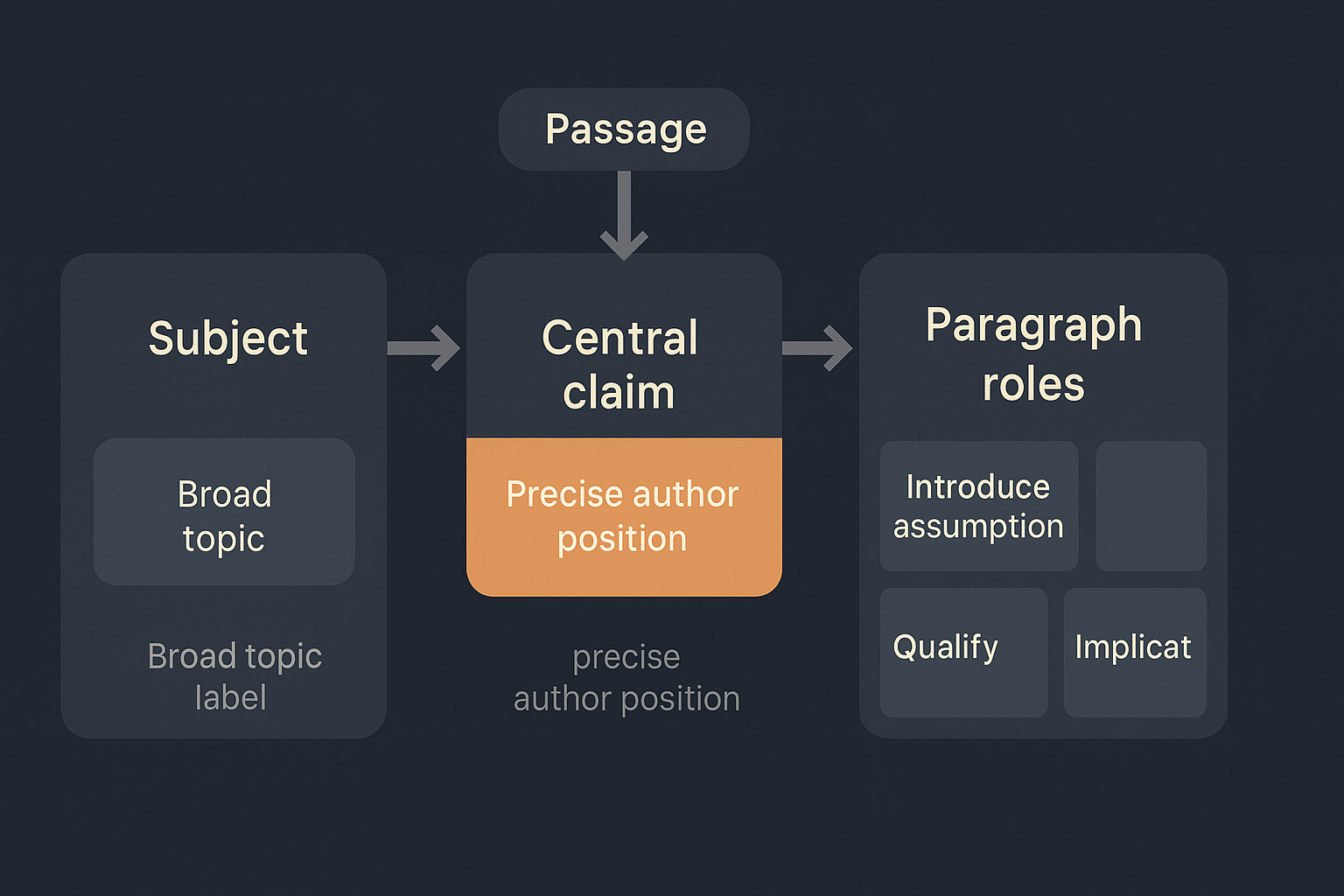
- What is the subject? Identify the broad topic in a few words.
- What is the author’s position? Complete the sentence: “The author’s main point is that…”
- How does each paragraph contribute? Identify whether it introduces a problem, challenges an assumption, supplies evidence, qualifies a claim, or draws an implication.
Pay attention to transitions such as however, although, because, therefore, and for example. These words often reveal the logical relationship between sentences.
Avoid highlighting entire sentences or every unfamiliar word. If a word does not affect the argument, infer its broad function from context and continue. Return to it only if it becomes relevant to a question. In RC, vocabulary matters mainly when it changes your understanding of a key claim, contrast, or conclusion.
Build a three-step passage map
A concise passage map helps you answer several questions without rereading aimlessly.
1. Subject
Name the topic briefly: “digital access and museums” or “metrics in public policy.”
2. Central claim
State the author’s position in one sentence. Include an important qualification if the author makes one.
3. Paragraph roles
Assign each paragraph a function rather than writing a detailed summary. A map might look like this:
- P1: introduces a common assumption;
- P2: gives reasons to question it;
- P3: adds a qualification; and
- P4: states the broader implication.
This method prevents a common error: remembering examples but missing the argument they were meant to support. It also gives you a reference point for main-idea, inference, tone, and author-purpose questions.
How to choose the first passage
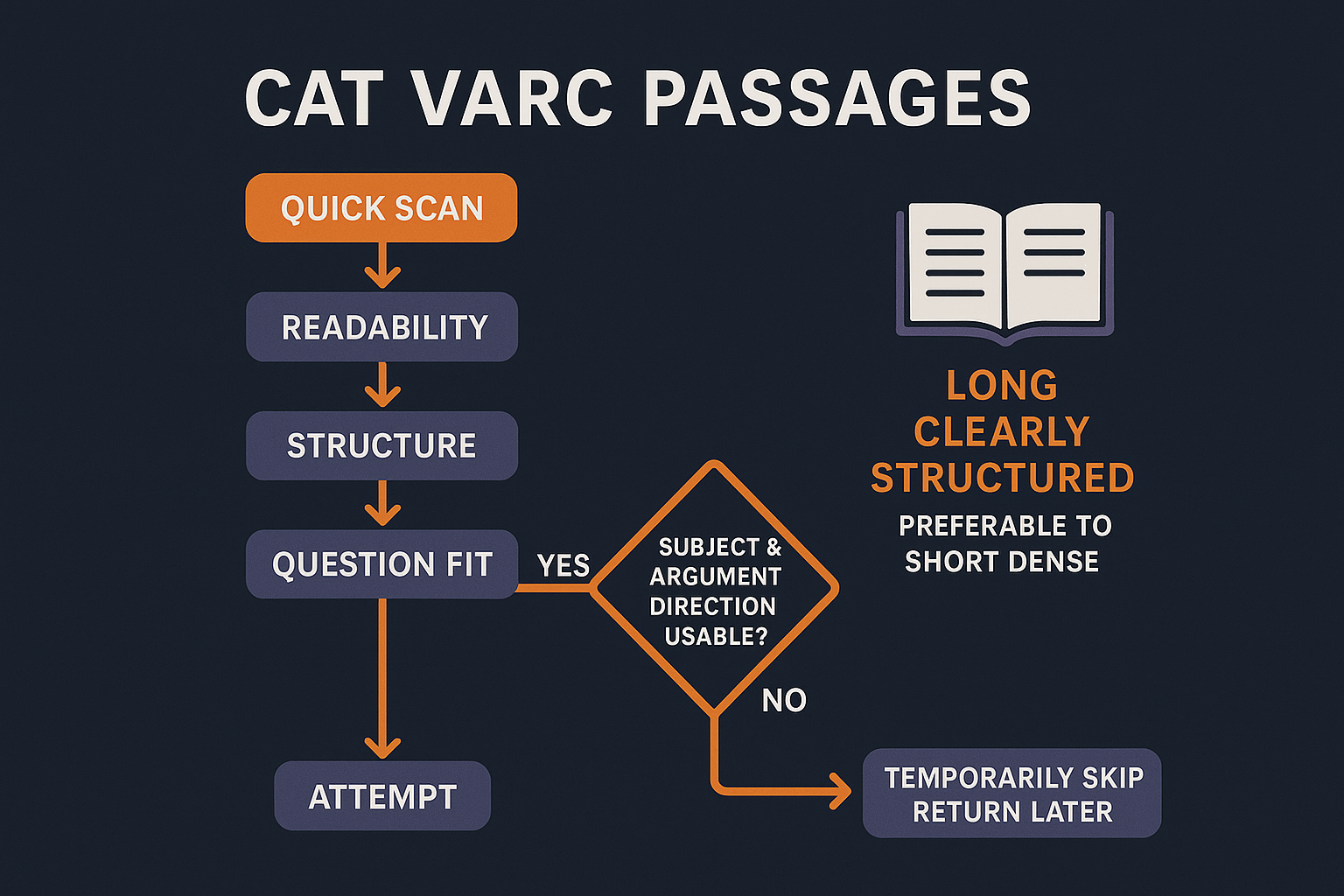
Passage selection is a decision under uncertainty. Do not choose only by length or subject familiarity. In the initial scan, assess four features:
- Readability: Can you follow the sentences without repeated rereading?
- Structure: Is there a visible progression, contrast, or argument?
- Question fit: Do the questions appear answerable from the text?
- Cost: Will the passage demand excessive effort because its references or syntax are unusually dense?
A longer passage with clear paragraph roles may be a better first choice than a short passage with compressed reasoning. Likewise, a familiar subject can still produce difficult questions if the author’s position is subtle.
Use a stop-loss rule: if, after a focused first read, you cannot state the subject and likely direction of the argument, leave the passage temporarily. Revisit it only after checking whether another passage offers clearer evidence and better time value. This prevents a sunk-cost trap.
Classify the question before solving it
For practice, classify RC questions into these families. The labels are useful only if they tell you what kind of evidence to seek.
Main idea or central argument
Ask what the passage is primarily trying to establish. The correct option usually captures the author’s argument, including a major qualification where relevant. An option describing one example or merely naming the topic is incomplete.
Detail or textual information
Locate the relevant sentence or paragraph. Check small distinctions such as may versus will, some versus all, or often versus always.
Inference
Choose a conclusion that follows from the passage, not one that is merely sensible in the real world. An inference should be strongly supported by the text and should not require an outside assumption.
Tone
Judge the author’s attitude from the language and reasoning. “Cautious,” “critical,” “qualified,” and “skeptical” are often more accurate than dramatic labels such as “hostile” or “dismissive.”
Application
Identify the principle established by the passage, then test whether the new situation satisfies that principle. Do not import a new rule simply because the application option sounds practical.
Author purpose or paragraph function
Ask what the author is doing: defining, challenging, illustrating, qualifying, comparing, or extending an idea. The subject of a paragraph is not necessarily its function.
Eliminate attractive but incorrect options
When two options seem plausible, compare each with the passage’s exact boundaries. Use these checks:
- Scope: Does the option cover more or less than the passage?
- Contradiction: Does it reverse a stated point?
- Distortion: Does it turn a qualified claim into an absolute one?
- Unsupported inference: Does it add a conclusion the passage does not establish?
- Extreme wording: Does it use always, never, only, or completely without support?
Write elimination reasons precisely. “Too broad because it applies the claim to every institution” is more useful than “sounds wrong.” This habit improves both accuracy and review quality.
Worked example 1: mapping and main idea
Original passage:
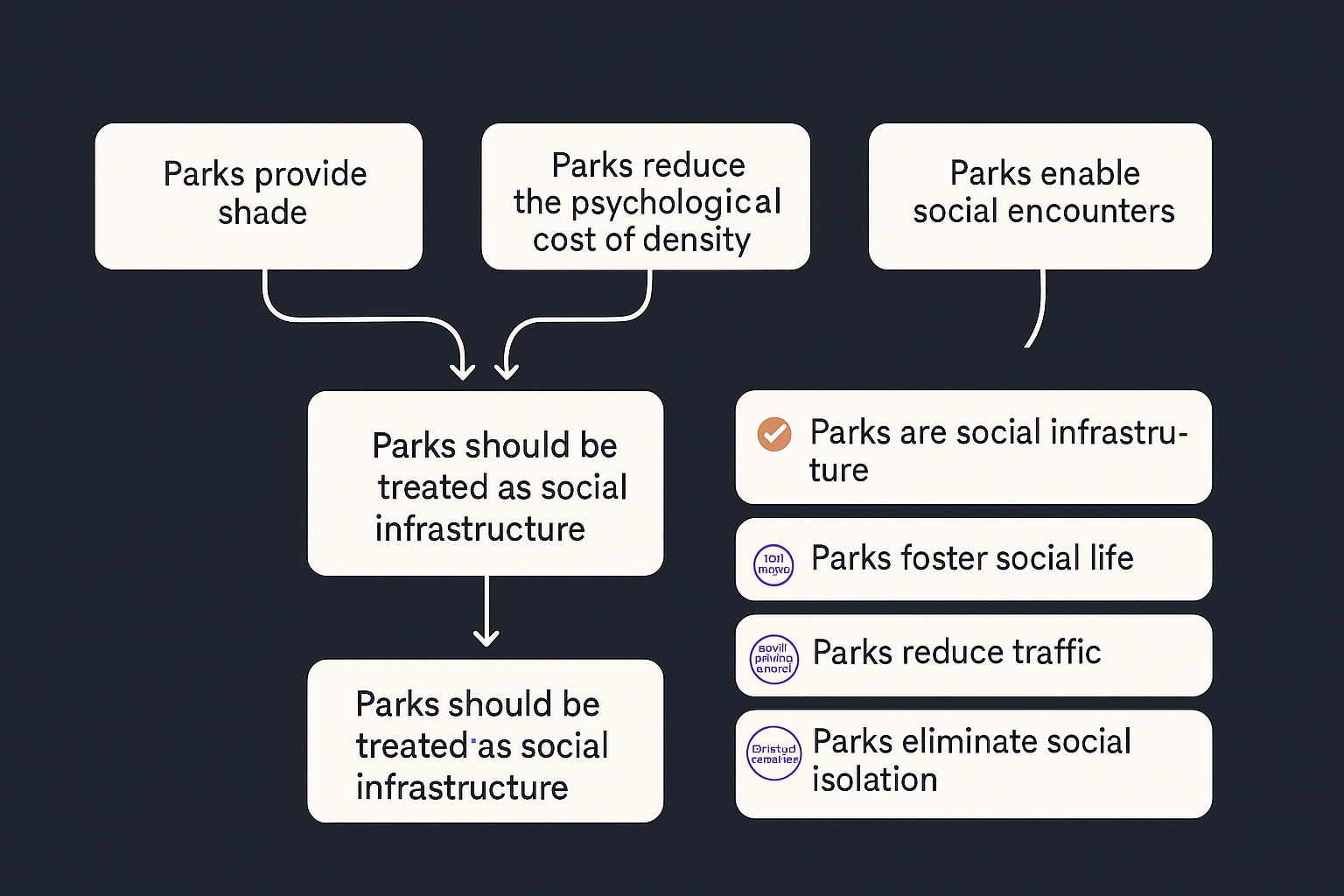
Cities often treat public parks as decorative spaces: pleasant to look at, but secondary to roads, offices, and housing. Yet a park’s value is not limited to recreation. It can provide shade, reduce the psychological cost of dense living, and create occasions for brief encounters among people who would otherwise remain strangers. These benefits do not mean that every vacant plot should become a park. They do suggest that urban planning should evaluate open space as social infrastructure rather than as unused land awaiting construction.
Question: Which option best captures the central idea?
A. Every vacant urban plot should be converted into a public park.
B. Public parks have social and environmental value that urban planning should recognise beyond their decorative function.
C. Roads, offices, and housing are less important to cities than open spaces.
D. People who live in dense cities are psychologically unable to form social relationships.
Answer: B
Map: The subject is the role of public parks. The central claim is that parks provide wider social and environmental benefits and should be treated as infrastructure. The final sentence gives the planning implication.
Why the tempting options fail: A is contradicted by the statement that not every vacant plot should become a park. C invents a comparison the author never makes. D changes a possible benefit of parks into an absolute claim about all urban residents.
Worked example 2: using stated evidence for inference
Original passage:
A museum that adds digital reproductions of its collection may reach viewers who cannot travel to the building. This wider access, however, does not make the physical museum irrelevant. The experience of moving through a curated space, noticing scale, and comparing works in the same room can produce forms of attention that a screen does not replicate. Digital access should therefore be understood as an extension of the museum’s public role, not as a complete substitute for visiting it.
Question: Which of the following can be most reasonably inferred?
A. Digital reproductions are useful only to people who have already visited a museum.
B. Physical museums should stop investing in online access.
C. Online and physical museum experiences can serve different but complementary purposes.
D. Viewing art on a screen prevents a person from paying sustained attention.
Answer: C
The passage states that digital access widens reach while a physical visit offers experiences a screen does not replicate. The supported inference is that the two formats have different, complementary functions.
A is contradicted by the reference to people who cannot travel. B conflicts with the recommendation to treat digital access as an extension of the museum’s role. D is too extreme: the passage identifies one experience that screens do not replicate; it does not say screens prevent all sustained attention.
Worked example 3: identifying a scope error
Original passage:
Measurement can improve public policy, but only when policymakers understand what a measure leaves out. A school’s attendance rate may reveal whether students are present, yet it says little about what they learn while there. Similarly, a hospital’s average waiting time may conceal large differences between patients. Metrics are therefore useful starting points, not complete descriptions of institutional performance.
Question: Which statement best reflects the author’s view?
A. Quantitative measures are misleading and should not be used in public policy.
B. No single metric can capture every relevant aspect of an institution’s performance.
C. Attendance rates are less useful than hospital waiting times.
D. Policymakers should replace metrics with personal judgments.
Answer: B
B preserves both parts of the argument: metrics are useful, but incomplete. A is too broad because the author explicitly says measurement can improve policy. C compares the examples without support. D introduces a replacement method the passage never recommends.
A CAT VARC practice progression
Use three stages so that speed does not develop at the expense of comprehension.
Stage 1: untimed accuracy
Complete one passage carefully. For each question, record the supporting sentence or paragraph and one reason each rejected option fails. Your measure is not completion time; it is whether your answer can be defended from the text.
Stage 2: controlled timing
Introduce a flexible time limit. After the set, record where time went: slow reading, repeated rereading, option indecision, or poor selection. Correct the process causing the delay rather than simply trying to read faster.
Move to controlled timing after maintaining at least 80% accuracy across three varied passages, provided your explanations are evidence-based. This is a practice checkpoint, not a guarantee of any CAT score or percentile.
Stage 3: mixed timed sets
Combine different subjects, structures, and question types. Use timed verbal practice to test passage selection, switching between passages, and decision-making under pressure. The objective is not to attempt every question automatically; it is to maximise accurate decisions within the available time.
For structured RC practice, vary passage difficulty and record performance by question type rather than counting only total passages.
Review wrong answers with an RC error log
Record each error in a compact format:
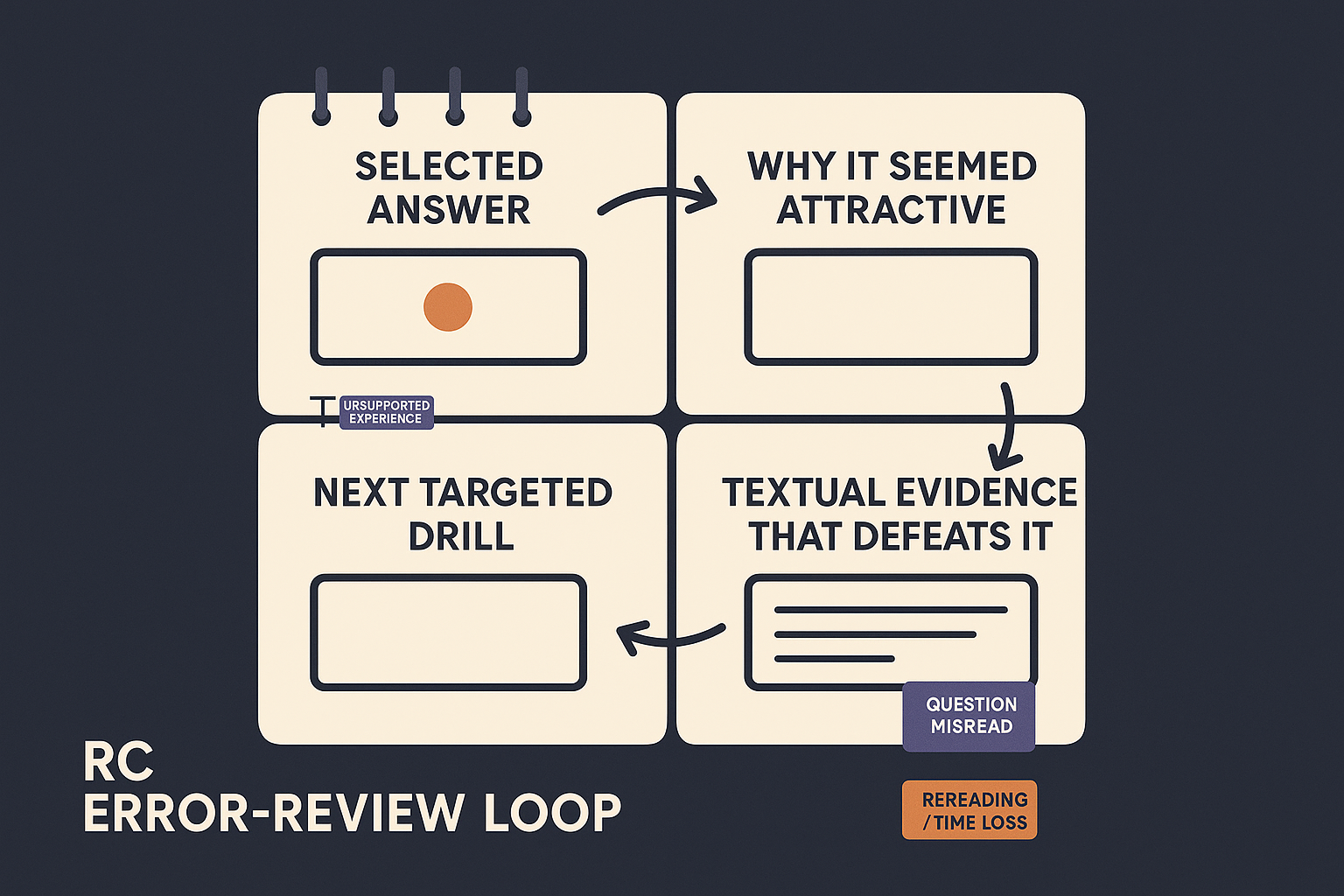
| Passage/question | My answer | Error cause | Textual proof | Next drill | |---|---|---|---|---| | Inference | Option A | Unsupported inference | The passage says “may,” not “will” | Qualified-claim questions |
Useful categories include comprehension, question interpretation, inference, option evaluation, vocabulary in context, and time or process. Also record correct guesses: a right answer reached without evidence is an unstable success.
For every error, answer three questions:
- What made my option attractive?
- Which word, sentence, or paragraph defeats it?
- What rule will I apply next time?
Review the log weekly. If scope errors dominate, use targeted accuracy practice before returning to mixed sets. If comprehension errors dominate, slow down the first read and improve the passage map. If time errors dominate, inspect selection and rereading habits rather than adding random passages.
How CAT RC skills transfer to other exams
The underlying abilities transfer, but exam strategy does not transfer unchanged.
| Core skill | Feature that may differ by exam | Practice adjustment | |---|---|---| | Argument tracking | Passage difficulty and question mix | Practise varied structures, not only familiar topics | | Inference and evidence use | Wording and option traps | Review why each option is supported or unsupported | | Passage selection | Section time pressure and overall design | Rehearse selection decisions under the target exam’s current format | | Reading efficiency | Relative weight of RC and other verbal tasks | Use full-section mocks before finalising time allocation |
Use CAT preparation to build the reading and reasoning base. For XAT, IIFT, SNAP, or NMAT, verify the current format and use representative material before changing timing or attempt strategy. The transferable skill is evidence-based comprehension, not a fixed CAT routine.
A repeatable weekly plan
- Day 1: Complete one untimed passage and write its subject, claim, and paragraph roles.
- Day 2: Practise detail and inference questions with textual proof.
- Day 3: Practise main idea, tone, and purpose questions, focusing on scope.
- Day 4: Complete a controlled-timing passage and diagnose the time loss.
- Day 5: Do a mixed set and make a deliberate first-passage decision.
- Day 6: Review the error log and complete one targeted drill.
- Day 7: Rest or read lightly, summarising each paragraph in one sentence.
Increase volume only when review remains thorough. A smaller set of carefully analysed CAT RC passages is more valuable than a large collection completed without diagnosis.
Frequently asked questions
How many passages should I practise for CAT VARC?
There is no universal number. Aim for variety across structure, subject, length, and question type. Move from one-passage analysis to mixed timed sets only when you can explain both correct answers and tempting wrong options.
How should I choose the first passage?
Prefer a passage whose language and structure you can follow and whose questions appear text-answerable. Do not choose only by length, topic familiarity, or the first few easy-looking lines. Leave a passage when its initial read does not produce a usable subject-and-claim map.
What are common CAT RC question types?
For practice, classify questions as main idea, detail, inference, tone, application, or author purpose. The categories may overlap, so always let the wording of the question determine the evidence you need.
How should I review a wrong answer?
Write your selected option, why it seemed plausible, the textual proof that defeats it, and the next drill required. Distinguish a comprehension mistake from an option-elimination mistake; they require different corrections.
Can CAT RC skills help with XAT, IIFT, SNAP, and NMAT?
Yes. Argument tracking, inference, evidence use, and elimination are broadly useful. However, passage mix, timing, and section design may differ, so verify each exam’s current format and practise accordingly.
How can I pursue a high VARC percentile?
Build reliable accuracy first, then add timing and selection under pressure. Do not treat a fixed attempt count, score, or practice volume as a percentile guarantee. Use current exam information and your mock data to set provisional goals.
A practical way to build this skill
In practice, strong CAT VARC preparation connects careful reading, evidence-led elimination, and honest review. Practise in small sets, name the exact reason behind every option you reject, and revisit errors after a gap so that the lesson survives beyond one passage. The learning systems at Auctor Labs are designed around this kind of deliberate skill-building. If you want a focused next step, you can put this CAT RC strategy into practice and use the feedback to guide the next session. For a complementary perspective, read about a broader CAT reading comprehension strategy.
 Start practising with Auctor RC