
The flashcard and the passage
She flips a familiar card: sesquipedalian — long‑winded. Confident, she tucks it away. Minutes later a VARC passage asks whether the author's attitude toward ‘sesquipedalian’ expression is admiring, ironic, or alarmed. The flashcard supplies a definition; it does not supply the rhetorical coordinates that make one of those answers decisive.
The scene is familiar because it feels efficient. Word lists are measurable, finite and satisfying: you can mark a stack as "done." That immediate feedback loop helps explain why vocabulary study is so popular. But this pedagogical observation also reveals a hidden cost. In coaching and classroom observation, a word‑first habit can encourage readers to treat isolated lexical items as the decisive units of meaning. On many VARC questions—especially inference, tone and authorial‑purpose items—that habit often misdirects attention away from structure, perspective and argumentative moves.

Why the word‑first myth still looks right
The belief that memorising words is the fastest path to better VARC scores rests on three seductive truths. First, learning vocabulary is verifiable: you can test recall and feel measurable progress. Second, vocab study scales easily into products—lists, apps and mnemonic tricks—so it presents as a neat program of work. Third, lexical knowledge does something undeniably useful: it reduces friction when encountering dense sentences.
Those truths make the habit sticky, but they also obscure a distinction that matters for the exam: word knowledge lowers the cost of recognition; it does not teach you how clauses fit together, whose claim is being reported, or which sentence qualifies another. VARC frequently prizes integration over identification. Flashcards tell you what a word can mean; passages ask what a sentence is doing.
Three micro‑passages that make the problem visible
These short, original passages are diagnostic rather than drills. Each is followed by a reading sketch showing how a word‑first approach leads to a predictable misread and a concise takeaway that maps to common VARC question types.
Passage A
"He championed the abstruse philosophy of the academy, praising its abstruseness as a defense against vulgar simplicity. Critics accused him of obscurantism; he replied that the true enemy was facile clarity."
Word‑first read: A test‑taker who underlines abstruse and obscurantism and remembers both mean ‘hard to understand’ may conclude the passage endorses obscurity and therefore pick an answer that labels the author as celebratory of complexity.
Structural read: Track roles and moves. The paragraph reports two viewpoints—praise and accusation—and then records the subject’s counterargument. The rhetorical move is reportage of a dispute, not an endorsement. Questions about author attitude or main point hinge on whose voice the passage privileges; here the author remains reportive.
Takeaway: Likely harmed Q‑types — author attitude/tone and inference about endorsement.
Passage B
"The colony's merchants lauded the new currency for stabilising trade, but port workers noticed prices edging up—an unnoticed levy. The merchants saw continuity; the workers glimpsed redistribution."
Word‑first read: Encountering ‘levy’ might trigger a flashcard memory—tax or imposition—and the reader may assume the passage is centrally about fiscal policy, selecting an answer about taxation.
Structural read: The paragraph juxtaposes two perspectives with an explicit contrast. The central move is perspective‑tracking: merchants and workers see different outcomes. Whether 'levy' connote tax or hidden charge is subordinate to the fact that observers disagree. Main‑idea and viewpoint questions require noticing that contrast rather than privileging a single lexical token.
Takeaway: Likely harmed Q‑types — viewpoint/source attribution and main idea.
Passage C
"Marina’s late‑career philanthropy drew praise and suspicion; some argued it masked vanity, others saw sincere atonement. Her gestures mattered less to the historian than the patterns they completed."
Word‑first read: Focusing on ‘philanthropy’ and ‘atonement’ can nudge a reader toward a motive‑centered interpretation—did she act out of sincerity or showmanship?—because those words carry strong valence on flashcards.
Structural read: The last sentence reframes the paragraph: the author cares less about Marina’s motives and more about what the actions reveal for a historical pattern. The passage shifts from moral psychology to methodological concern; a word‑centric reader is likely to pick a motive‑focused answer and miss the author’s analytical stance.
Takeaway: Likely harmed Q‑types — authorial purpose and inference about method.
These examples are classroom vignettes, not empirical proof. Still, they illustrate a pedagogical pattern: surface semantics can seduce readers into answering questions the passage never posed. Competent performance on VARC depends less on isolated word identification than on tracking relations and moves.
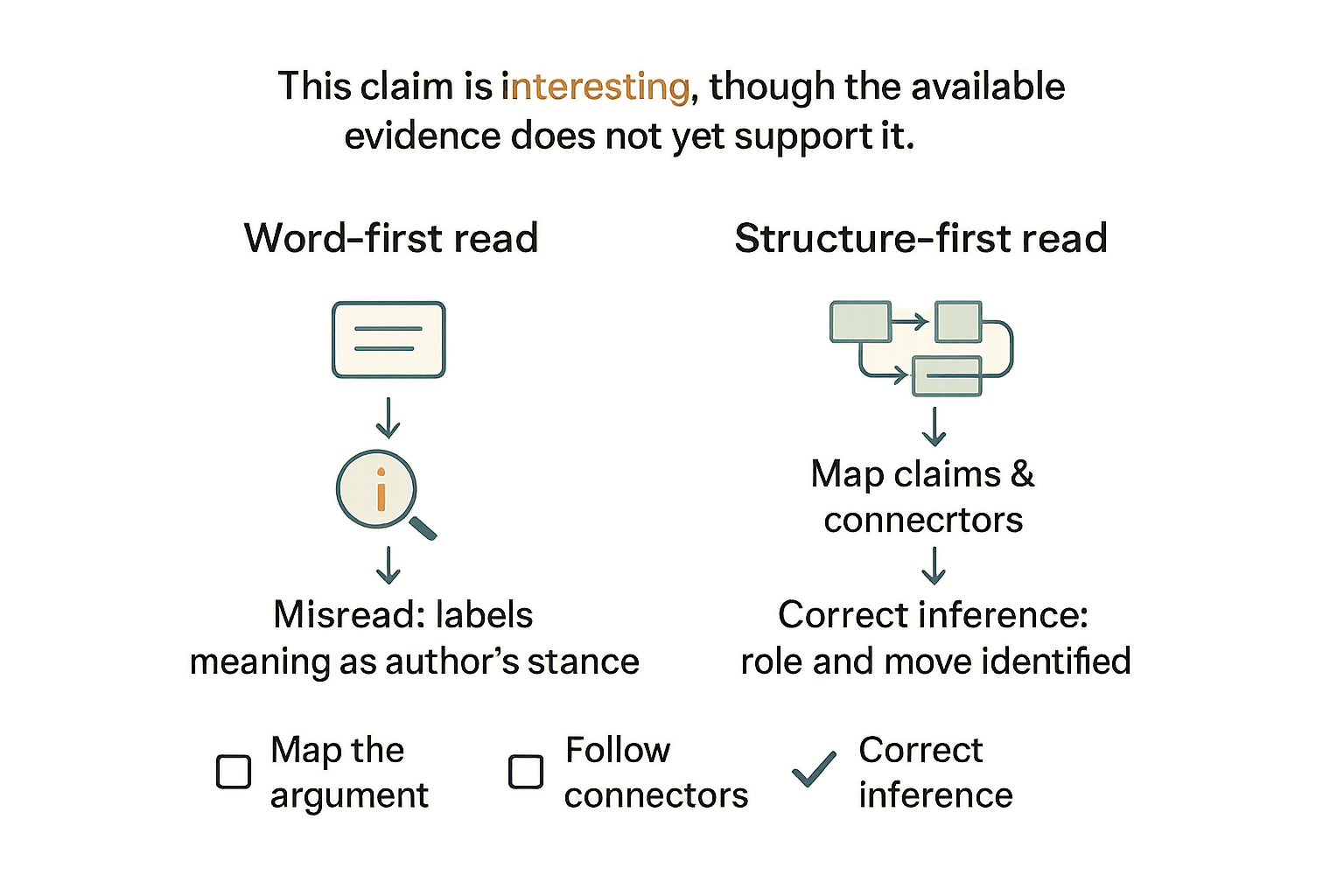
How to read differently: three cognitive shifts that transfer
Replace the “lookup‑and‑label” reflex with mental habits that prioritize function over definition. These are cognitive lenses rather than stepwise drills; use them while you read to change the default question each sentence invites.
First, map the argument. Before seeking rarer words, sketch the passage’s skeleton in your head. Who is making claims? Which sentences offer support, contrast, or qualification? A quick mental map exposes where the real questions live.
Second, follow connectors and signals. Words like however, thus, whereas, and nevertheless do the heavy lifting of structure. Noticing them identifies argumentative turns without needing a deep cache of obscure lexis.
Third, track perspective. Label the voices in the text—the author, sources, critics, groups. Many errors occur when a reader attributes a quoted opinion to the author or vice versa; making perspective explicit avoids that trap.
These shifts change the immediate prompt from "What does this word mean?" to "What is this sentence doing in the passage’s argument?" Vocabulary becomes supportive, not central.
Quick concept checklist (brief answers to frequent reader questions)
- How to improve reading comprehension for CAT VARC: prioritise structure-first habits—summarise the passage’s single central move in one sentence, label the voices you meet, and practise mapping connectors under timed conditions. Treat vocabulary as a reducer of friction, not the primary cue for answers.
- Which factors influence understanding of syntax: sentence embedding and length, punctuation and clause boundaries, modifier placement, and discourse markers (however, thus, because). When stuck, segment the sentence into clauses, identify the main subject and verb, then paraphrase.
- How to aim for full marks on comprehension passages: answer from the passage’s rhetorical roles and explicit support; eliminate choices that rely on connotation or external knowledge; prefer answers that reference relations (qualification, cause, contrast) over single-word meanings.
- What is the purpose of the reading text?: look for the author’s operative move—are they arguing, qualifying, reporting a debate, comparing positions, or reframing evidence? The author’s move (not the topical label) determines correct responses about tone, purpose and inference.
These short concept answers map directly to the cognitive shifts above and give a compact bridge from habit change to practice.

A compact diagnostic checklist to run after each passage
- Can you state the author's single most important move in one short sentence? If not, you are probably prioritising words over structure.
- After finishing the passage, can you name two distinct perspectives or claimants the passage mentions? If you can name only words you underlined, your reading leaned lexical.
- Do your likely answers depend on the connotations of one term rather than on sentence relations? If yes, suspect false precision.
These quick checks are practical heuristics born of teaching experience rather than formal empirical claims; they help surface the habit in real time.
Where vocabulary helps, what it doesn't, and how to reallocate effort
Vocabulary matters when it reduces friction on dense syntax or when a precise term carries a conceptual distinction critical to the argument. It does not help when learners treat word lists as a substitute for mapping relations between claims.
A sensible allocation: devote the majority of practice time to reading for structure and inference; keep vocabulary study contextual and limited to high‑frequency or conceptually loaded terms. Concretely, study new words inside sentences and prioritise exposure to passages that force you to label moves, not just meanings.
Practical, minimal steps to start (two modest actions):
- Read one short editorial daily and write a one‑sentence summary of its central argumentative move.
- When you add a new vocabulary item, note one sentence showing its pragmatic use rather than memorising an isolated definition.
If you want passage‑level techniques after you realign your habit, consult CAT VARC Passages: A Skill‑Building Guide and then use targeted practice to apply the structural lenses under timed conditions.
Two final sentences
The single most important habit to change is the reflex to stop at words and start at moves: make the passage’s architecture your first question. Begin tomorrow by summarising one editorial in a sentence and by attaching every new word you learn to a sentence that shows its pragmatic use.
A practical way to build this skill
In practice, strong CAT VARC preparation connects careful reading, evidence-led elimination, and honest review. Practise in small sets, name the exact reason behind every option you reject, and revisit errors after a gap so that the lesson survives beyond one passage. The learning systems at Auctor Labs are designed around this kind of deliberate skill-building. If you want a focused next step, you can put this CAT RC strategy into practice and use the feedback to guide the next session. For a complementary perspective, read about a broader CAT reading comprehension strategy.
 Start practising with Auctor RC